Emergency Court Filing Names The Ledges HOA, Valderra Development Entities, Valderra Land Holdings, and Individual Board Members in Dispute Over Governance, Spending, and Transparency
A Temporary Restraining Order seeks to pause non-urgent expenditures and compel records disclosure while the court reviews claims involving HOA governance, financial management, and declarant control.
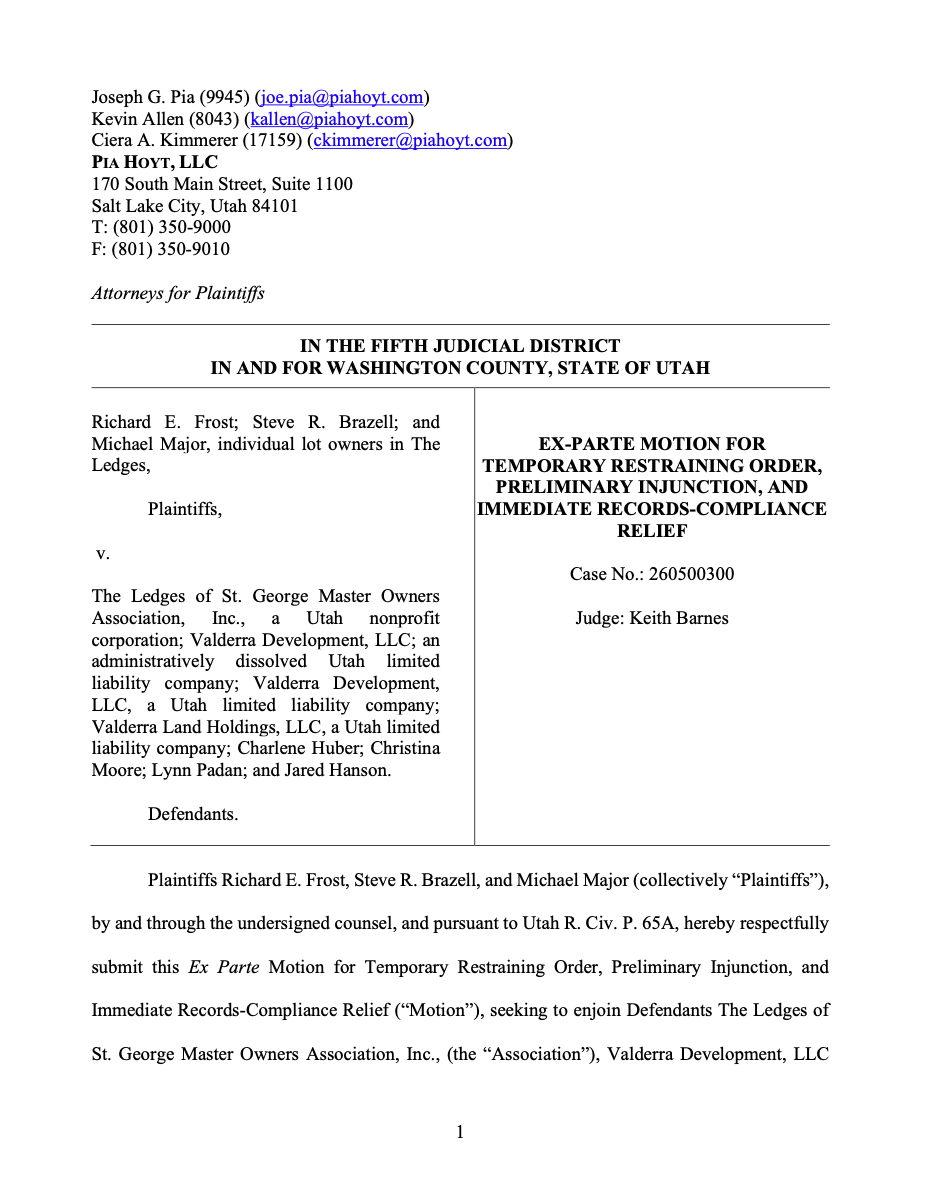
A recently filed Ex Parte Motion for Temporary Restraining Order and Preliminary Injunction in Washington County, Utah, brings forward a series of legal claims concerning governance, financial transparency, and decision-making authority within The Ledges of St. George community.
The action, filed by individual homeowners, names multiple defendants, including The Ledges of St. George Master Owners Association, Inc.; Valderra Development, LLC (in multiple forms); Valderra Land Holdings, LLC; and individual board or affiliated members including; Charlene Huber, Christina Moore, Lynn Padan (aka., F. Lynn Padan), and Jared Hanson. The motion does not determine liability. Instead, it asks the court to temporarily intervene to preserve the current financial and governance position of the Association while the underlying claims are evaluated.
At the center of the filing is a request to halt a planned asphalt surface treatment project scheduled for mid-April 2026. According to the motion, the proposed work is characterized as preventative rather than emergency in nature, with no immediate safety or structural concerns identified in recent inspections. Plaintiffs argue that proceeding with the project would result in a substantial and irreversible use of Association funds, which they contend should be preserved until questions regarding financial oversight and authorization are resolved.
The filing also raises concerns about broader financial management practices. Specifically, it alleges a lack of transparency around certain legal expenditures and requests court-ordered disclosure of records, including invoices, authorizations, and related financial documentation. The motion asserts that homeowners have previously sought access to these records under Utah law but have not received complete responses.
In addition to financial issues, the motion challenges aspects of governance and control within the Association. It references recent statutory changes in Utah law governing the duration and limits of declarant control, and questions whether current structures comply with those requirements. The court is being asked to maintain the status quo by temporarily restricting certain governance changes while these legal questions are addressed.
The legal standard for a temporary restraining order requires the court to consider whether there is a likelihood of success on the merits, whether irreparable harm may occur without intervention, whether the balance of harms favors relief, and whether such relief aligns with the public interest. The motion argues that these conditions are met, particularly due to the potential for irreversible financial impact and the ongoing nature of the disputed actions.
Importantly, the filing does not seek to disrupt routine operations of the Association. Instead, it proposes a limited pause on specific categories of spending and actions, along with requirements for document preservation and statutory compliance, until a full hearing can be conducted.
The matter is currently pending before the court. No findings have been made, and all claims remain subject to judicial review.